
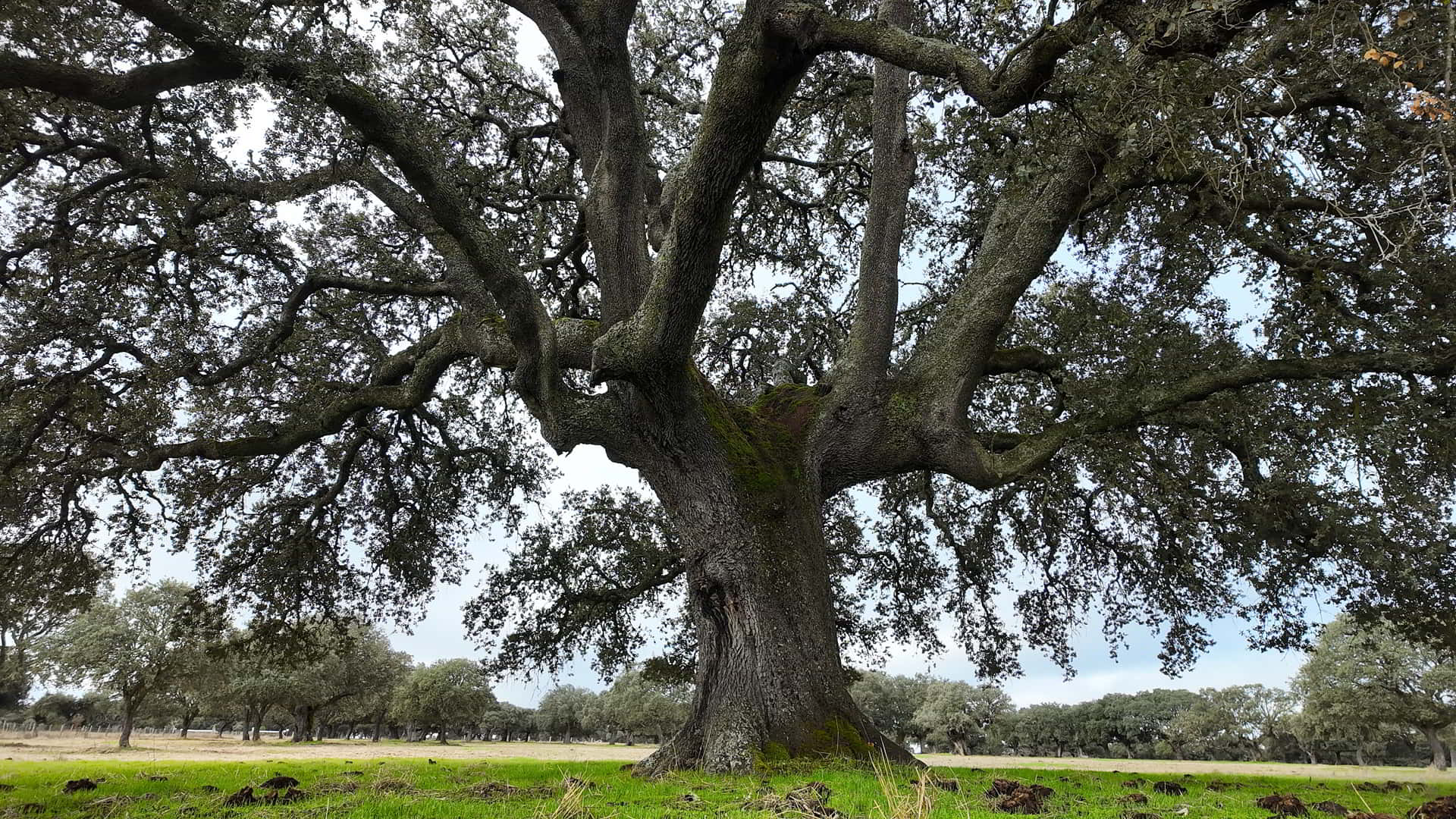
La Encina del Águila (the Holly Oak of El Águila) is one of the most remarkable and emblematic trees in the province of Salamanca, Spain. This monumental holm oak (Quercus ilex subsp. ballota) stands on the estate known as “El Águila” in the municipality of Fuentes de Oñoro, in the western part of the province, very close to the Portuguese border. The tree is an outstanding representative of the dehesa ecosystem—a human‑shaped silvopastoral landscape of great ecological and cultural value that dominates western Salamanca. Its name evokes the rich wildlife of the area, where golden eagles and other raptors can be seen, while its majestic size makes it a natural monument admired by all who encounter it.
Key Information
- Name: Encina del Águila (Quercus ilex subsp. ballota)
- Location: El Águila estate, municipality of Fuentes de Oñoro, province of Salamanca, Castile and León, Spain
- Access: Reached via a track that crosses the A‑62 motorway (Ruta de la Plata) and the old N‑620 road
- Ownership: Private estate
- Ecosystem: Dehesa of holm oaks, a traditional silvopastoral system typical of the western Iberian Peninsula
Physical Characteristics and Longevity
This specimen stands out for its exceptional dimensions, its majestic shape, and its great age, which places it among the most long‑lived trees in its surroundings.
- Form and singularity: It has a tall, globose, regular and semi‑spherical crown of spectacular dimensions, making it stand out notably among the other holm oaks in its vicinity.
- Special feature: Its canopy hosts a nest—a living testament to the rich biodiversity of the area. It is not known for certain whether the tree’s name (“of the Eagle”) comes directly from the presence of eagles, but the estate itself is called “El Águila” (The Eagle).
Characteristic
Total height
Trunk circumference
Canopy diameter
Estimated age
Measurement
21 metres
4.60 metres (at 1.30 m above ground)
30.7 metres
Approximately 500 years
Ecological and Historical Significance
The Encina del Águila is far more than an ancient tree; it is a living symbol of the Salamanca dehesa—an ecosystem that harmonises traditional human activities (livestock rearing, agriculture) with exceptional biodiversity conservation.
- Biodiversity refuge: The dehesa where it grows is home to numerous raptor species, including the golden eagle, griffon vulture, and black stork, as well as mammals such as wild boar, roe deer, and red fox. The fact that the tree holds a nest in its crown underscores its role as a shelter for local wildlife.
- Witness to history: At approximately 500 years old, this oak has witnessed countless historical events. Its territory, on the border with Portugal, was the scene of battles and troop movements, especially during the Peninsular War (1807–1814), when the nearby village of Fuentes de Oñoro was the site of a famous battle. The El Águila estate was already recorded in the mid‑19th century in Pascual Madoz’s geographical dictionary.
- A natural monument: Although it is not officially catalogued by the regional government of Castile and León, its size, age, and form make it a singular tree of great heritage value. It embodies the essence of the centuries‑old dehesas that have given the province of Salamanca its renown for products such as acorn‑fed Iberian ham.
Conservation and Visiting
- Conservation status: The tree is in good condition and is protected within a private estate, which limits direct public access but helps ensure its preservation.
- How to visit: As it lies on private land, it is not a public site with marked trails for free visitation. Nevertheless, its impressive silhouette can be admired from nearby roads and tracks, such as the A‑62 motorway. For nature lovers and enthusiasts of singular trees, it can be included as a destination on a route through the dehesas of western Salamanca.
- Broader context: It is worth noting that the Encina del Águila is sometimes confused with other famous oaks, such as the Encina Terrona in Extremadura, which is older (over 800 years) and located in Zarza de Montánchez (Cáceres). While the Encina Terrona is known as the largest and oldest holm oak in Spain, the Encina del Águila is a unique treasure belonging to the province of Salamanca.
An Icon of the Salamanca Dehesa
The Encina del Águila is a magnificent example of nature’s capacity to produce long‑lived, majestic living beings. It represents the resilience, history, and biodiversity of the dehesas of Salamanca. Although access is restricted, its existence serves as a reminder of the value of these landscapes and the importance of conserving these green giants, which have been—and continue to be—the soul of the land of Salamanca.