
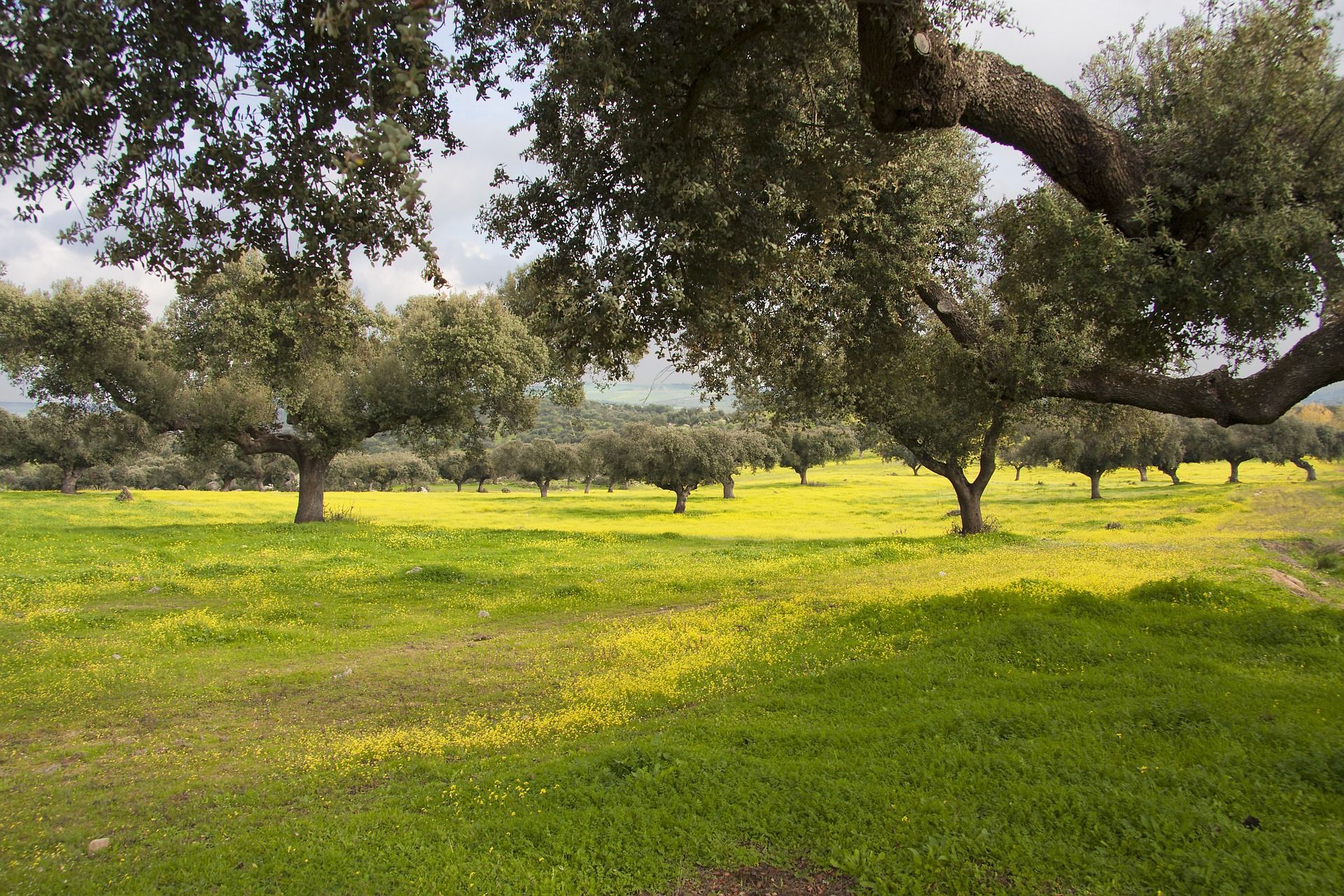
The Dehesa is one of Europe’s most distinctive and ecologically valuable landscapes—a human-shaped ecosystem that represents a perfect balance between conservation and sustainable land use. In the province of Salamanca, in the autonomous community of Castile and León, the dehesa reaches its fullest expression. This vast silvopastoral system, dominated by centuries-old holm oaks (Quercus ilex subsp. ballota) and cork oaks (Quercus suber), is a masterpiece of traditional land management. For over a thousand years, farmers and landowners have maintained this open woodland, using it for grazing livestock (the famous Iberian pigs), hunting, cork harvesting, and agriculture. In Salamanca, the dehesa is not merely a forest—it is a living cultural heritage, a biodiversity haven, and the foundation of some of Spain’s most renowned gastronomic products, including Jamón Ibérico de Bellota (acorn-fed Iberian ham). Recognized as a Habitat of Community Interest under the European Union’s Habitats Directive, the dehesa is a landscape where nature and human activity have coexisted in harmony for millennia.
Key Information
- Location: Province of Salamanca, Castile and León, western Spain. The dehesa landscape extends across the southern and western parts of the province, particularly in the comarcas of Ciudad Rodrigo, Vitigudino, Salamanca Campo Charro, and the foothills of the Sierra de Francia and Sierra de Béjar.
- Extent: Salamanca is one of the provinces with the largest dehesa surface area in Spain, with over 400,000 hectares of dehesa landscape.
- Status: Protected under European Union conservation frameworks (Natura 2000 Network). Much of the area is designated as ZEPA (Special Protection Area for Birds) and LIC (Site of Community Importance) .
- Ecosystem Type: Silvopastoral system—an open woodland of Mediterranean oaks with a understory of pasture, scrubland, and occasional cereal crops.
- Climate: Mediterranean continental climate with Atlantic influence. Hot, dry summers (average 25-35°C / 77-95°F) and cold winters with frequent frosts (often below 0°C / 32°F). Rainfall averages 400-800 mm annually, concentrated in spring and autumn.
Type of Trees and Flora
The dehesa is dominated by two main oak species, with the holm oak being the undisputed protagonist in Salamanca.
Dominant Tree Species:
- Encina (Quercus ilex subsp. ballota): The holm oak, or evergreen oak, is the quintessential tree of the Spanish dehesa. It is an evergreen tree with small, leathery, dark green leaves. Its most valuable feature is the sweet acorn (bellota) , which is larger and less bitter than those of other oaks. These acorns are the foundation of the Iberian pig-rearing system. Holm oaks are supremely adapted to the Mediterranean climate, with deep root systems that allow them to survive prolonged summer droughts.
- Alcornoque (Quercus suber): The cork oak is also present, particularly in the western and southern parts of Salamanca near the Portuguese border. It is distinguished by its thick, spongy bark, which is harvested every 9-12 years without harming the tree. Cork oaks are less frost-tolerant than holm oaks and occupy areas with milder winter temperatures.
Other Characteristic Flora:
- Pasture (Pastizal): The grassy understory consists of annual grasses, legumes, and herbs. Species such as Trifolium, Medicago, and Bromus provide high-quality forage for livestock.
- Scrubland (Matorral): In less intensively managed areas, the understory includes Mediterranean shrubs such as rockrose (Cistus) , heather (Erica) , gum rockrose (Cistus ladanifer) , rosemary (Rosmarinus officinalis) , and thyme (Thymus) .
- Riparian Vegetation: Along streams and rivers within the dehesa, willows (Salix) , poplars (Populus) , alders (Alnus glutinosa) , and ash trees (Fraxinus angustifolia) form lush gallery forests.
Longevity of the Specimens
The holm oaks of the Salamanca dehesa are among the longest-lived trees in Europe. Their longevity is a direct result of their biological resilience and centuries of careful stewardship.
- Ancient Encinares: Individual holm oaks (Quercus ilex) in the Salamanca dehesa commonly live for 300 to 500 years. Many specimens are estimated to be over 800 years old, with some exceptional individuals possibly exceeding 1,000 years. These ancient trees, often called “encinas centenarias” or “encinas milenarias,” are revered as living monuments.
- The Oldest Specimens: Certain dehesas in Salamanca—such as those in the municipalities of Ledesma, Almenara de Tormes, and the Campo Charro region—are home to holm oaks of immense size and age. One famous example is the Encina de la Peña de Francia in the foothills of the Sierra de Francia, a tree with a trunk circumference exceeding 8 meters and an estimated age of over 800 years. Another is the Encina de Tamames, a veteran tree with a massive, gnarled trunk that has witnessed centuries of history.
- Cork Oaks: Cork oaks also achieve great longevity, typically living 200 to 300 years, with some individuals reaching 500 years. Their ability to regenerate bark after harvesting allows them to outlive many other broadleaf trees.
- Growth and Senescence: These ancient oaks grow extremely slowly, adding mere millimeters to their trunk diameter each year. In their old age, they develop massive, twisted trunks, hollowed interiors (which provide critical habitat for birds, bats, and insects), and expansive, gnarled canopies. They are not static monuments but living, dynamic organisms that continue to produce acorns even after centuries.
Ecological and Cultural Importance
- Biodiversity Haven: The dehesa is one of Europe’s most biodiverse landscapes. Its mosaic of open woodland, pasture, scrub, and watercourses supports an extraordinary array of species:
- Birds: It is a stronghold for endangered raptors, including the Spanish imperial eagle (Aquila adalberti) , black vulture (Aegypius monachus) , griffon vulture (Gyps fulvus) , and black stork (Ciconia nigra) . It is also a wintering ground for cranes (Grus grus) .
- Mammals: The Iberian lynx (Lynx pardinus) , though rare, historically inhabited these dehesas. Other species include wild boar, red deer, roe deer, genets, and Egyptian mongooses.
- Dehesa-Specific Fauna: The most iconic inhabitant is the Iberian pig (Sus scrofa domesticus) , a breed uniquely adapted to this ecosystem. During the montanera (the autumn acorn-feeding season), these pigs graze freely among the oaks, transforming acorns into the world-famous Jamón Ibérico.
- Gastronomic Heritage: The dehesa is the source of Spain’s most prized cured meats. The Jamón Ibérico de Bellota (acorn-fed Iberian ham) is produced exclusively from pigs that have fattened on the acorns of these ancient oaks. The dehesa also produces cork, honey, game meat, and mushrooms (particularly Boletus edulis and Amanita caesarea).
- Soil Conservation and Water Regulation: The deep-rooted oaks prevent erosion, improve soil structure, and facilitate water infiltration. The dehesa acts as a sponge, capturing winter rains and slowly releasing them into aquifers and streams throughout the dry summer.
- Cultural Landscape: The dehesa is a human-made landscape, shaped by generations of deheseros (dehesa farmers). Traditional practices—such as poda (pruning), descabezado (pollarding), and controlled burning of scrub—have been refined over centuries. This is not a pristine wilderness but a cultural landscape of immense historical value, recognized by UNESCO as part of the Mediterranean agricultural heritage.
- Climate Change Resilience: The dehesa is remarkably resilient to climate variability. The deep-rooted oaks are drought-resistant, and the silvopastoral system provides a sustainable model for land management in an era of increasing aridity.
Visiting the Dehesa of Salamanca
The dehesa landscape is best experienced by exploring the countryside south and west of Salamanca city. Key routes include the Ruta de la Plata (A-66) south toward Béjar, the SA-300 toward Ledesma, and the winding roads through the Campo Charro region. Visitors can:
- Stay at Dehesa Estates: Numerous fincas and rural accommodations (casas rurales) offer stays on working dehesas, where guests can learn about Iberian pig rearing, oak management, and traditional agriculture.
- Visit Interpretation Centers: The Centro de Interpretación de la Dehesa in Salamanca and smaller local centers provide excellent educational resources.
- Hike or Cycle: A network of public trails (vías pecuarias, including ancient drove roads like the Cañada Real Soriana Occidental) crosses the dehesa, offering opportunities for walking, cycling, and birdwatching.
- Taste the Products: Local jamón producers and asadores (grill restaurants) in towns like Guijuelo (the capital of Iberian ham), Candelario, and Ciudad Rodrigo offer tastings of acorn-fed ham, chorizo, and other dehesa products.
- Birdwatching: The dehesa is a premier birdwatching destination, particularly during autumn and winter when cranes and other migratory birds arrive.
Conservation and Challenges
The Salamanca dehesa faces multiple pressures in the 21st century:
- Oak Decline (Seca): A complex syndrome known as la seca—caused by a combination of drought, fungal pathogens (Phytophthora species), and pests—is causing widespread oak mortality. Climate change is exacerbating this threat.
- Abandonment: Rural depopulation has led to the abandonment of traditional management in some areas, resulting in scrub encroachment, increased fire risk, and loss of the open woodland structure.
- Intensification: Conversely, some dehesas face pressures from agricultural intensification, overgrazing, or conversion to irrigated crops.
- Conservation Efforts: The European Union’s Common Agricultural Policy (CAP) , Natura 2000 designations, and regional conservation programs provide funding and frameworks for sustainable management. Organizations such as WWF Spain, SEO/BirdLife, and local mancomunidades work with landowners to promote practices that balance productivity with conservation.
Remember: When visiting, respect private property—most dehesas are working farms. Stay on public trails, close gates, avoid disturbing livestock (particularly during the montanera season), and never remove acorns or mushrooms without permission. These ancient oaks are irreplaceable; treat them with the reverence they deserve.
A Living Heritage
The dehesa of Salamanca is far more than a forest. It is a testament to the possibility of harmony between human activity and nature—a landscape where centuries-old oaks, free-ranging pigs, soaring eagles, and traditional farmers coexist in a delicate, enduring balance. To walk among these ancient encinas is to step into a landscape that has remained essentially unchanged for a thousand years, a living museum of Mediterranean culture and ecology.