
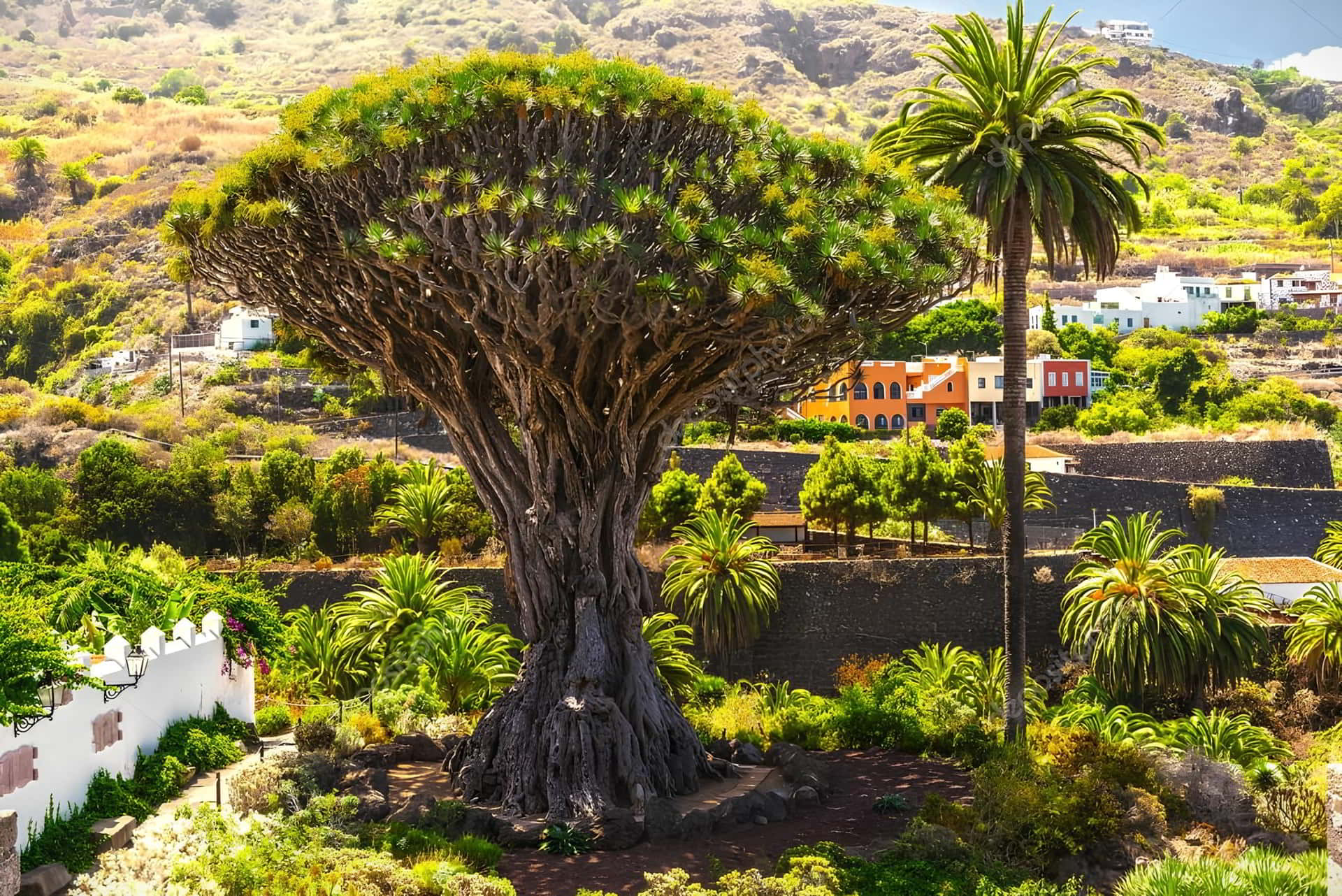
El Drago Milenario (the Thousand-Year-Old Dragon Tree) is one of the most iconic and revered natural monuments in the Canary Islands. Located in the municipality of Icod de los Vinos in northern Tenerife, this ancient specimen of Dracaena draco (Canary Islands dragon tree) is a symbol of the archipelago’s unique flora and cultural heritage. Considered the oldest living dragon tree in the world, it stands as a living testament to the volcanic origins and enduring spirit of the Canaries. Declared a National Monument in 1917, it remains one of Spain’s most visited natural attractions, drawing hundreds of thousands of visitors each year .
Key Information
- Name: Drago Milenario de Icod de los Vinos (Dracaena draco)
- Location: Icod de los Vinos, northern coast of Tenerife, Canary Islands, Spain
- Coordinates: 28°22′N 16°43′W
- Height: Approximately 21 metres
- Trunk circumference: Approximately 20 metres at the base
- Estimated age: Traditionally believed to be 1,000 years or more; modern scientific estimates range from 800 to 1,000 years
- Status: Declared a National Monument in 1917; protected under Canarian and Spanish law
- Access: Located within a public park (Parque del Drago) in the historic centre of Icod de los Vinos
Physical Characteristics and Singularity
The Drago Milenario is a botanical marvel, distinguished by its massive size, unusual form, and unique biological features.
| Characteristic | Measurement / Description |
|---|---|
| Height | 21 metres |
| Trunk circumference at base | 20 metres |
| Canopy diameter | Approximately 12 metres |
| Estimated age | 800–1,000 years |
| Trunk structure | Single massive trunk with multiple branching arms |
| Resin | Known as “dragon’s blood” (sangre de drago) — a deep red sap with medicinal and cultural uses |
- Unique biology: The dragon tree is a monocotyledon (like palms and lilies) rather than a true tree. It lacks growth rings, making precise age determination difficult. Its growth occurs in distinct phases, with branching occurring after flowering, creating its characteristic umbrella-like shape .
- Dragon’s blood: The tree’s resin, known as sangre de drago (dragon’s blood), is a deep red, viscous sap that has been used for centuries in traditional medicine, varnishes, and dyes. Its name derives from the ancient belief that dragons once inhabited the islands and that their blood gave rise to these trees .
- Morphology: The tree possesses a massive, gnarled trunk that branches into numerous arms, each tipped with dense clusters of sword-shaped, grey-green leaves. Its form is the result of centuries of growth, flowering cycles, and the selective pruning of its lower branches .
Longevity and Age Debate
The age of the Drago Milenario has been the subject of fascination and scholarly debate for generations.
- Traditional belief: For centuries, local tradition has held that the tree is over 1,000 years old, hence its name “Milenario” (Millenary). This belief was reinforced by historical accounts dating back to the 16th century that already referred to a large dragon tree in Icod .
- Scientific estimates: Modern botanical studies have refined this estimate. Because dragon trees lack annual growth rings, age is determined by measuring growth rates and counting the branching nodes (each branch represents a flowering event, which occurs roughly every 10–15 years). Current scientific consensus places the tree’s age between 800 and 1,000 years, making it the oldest known living dragon tree in the world .
- Historical context: At approximately 1,000 years old, this tree was already a mature specimen when the first European colonizers arrived in the Canary Islands in the 15th century. It witnessed the extinction of the indigenous Guanche people, the conquest of the archipelago, and the transformation of the islands over the last half-millennium .
Ecological and Cultural Significance
- A living fossil: The Dracaena draco is a relict species from the Tertiary period, once widespread across the Mediterranean basin and North Africa. It now survives only in the Canary Islands, Madeira, Cape Verde, and a few locations in Morocco. The species is a living fossil, representing a lineage that dates back millions of years .
- Symbol of the Canary Islands: The dragon tree is the quintessential symbol of the Canary Islands. Its silhouette appears on the islands’ coat of arms and is instantly recognizable worldwide. It represents the unique natural heritage of the archipelago and its volcanic landscapes .
- Sacred tree of the Guanches: The indigenous Guanche people of Tenerife revered the dragon tree. They believed it possessed magical and medicinal properties. The resin was used in embalming practices, and the hollowed trunks of ancient specimens were sometimes used as ceremonial spaces .
- Biodiversity value: The Drago Milenario is not an isolated monument; it is surrounded by a park that showcases a collection of other endemic Canarian plants, creating a small-scale botanical garden that highlights the archipelago’s unique flora .
- Economic and cultural hub: The tree is the centrepiece of Icod de los Vinos, a historic town known for its wines and traditional architecture. The Drago Milenario attracts over 400,000 visitors annually, making it one of Tenerife’s most important tourist attractions and a vital source of local economic activity .
Conservation and Visiting
- Conservation status: The Drago Milenario is in excellent condition thanks to continuous conservation efforts. In 1917, it became one of Spain’s first officially protected natural monuments. The surrounding park was established to protect its root system from trampling and urban encroachment .
- Recent threats: In 2002, a storm severely damaged one of the tree’s main branches, prompting a comprehensive conservation and restoration project. In 2021, volcanic ash from the Cumbre Vieja eruption on La Palma reached the tree, raising concerns, but no significant damage was reported .
- How to visit: The Drago Milenario is located in the Parque del Drago in the historic centre of Icod de los Vinos. The park is easily accessible and features:
- A well-maintained viewing platform for optimal photography
- An interpretation centre with exhibits on the tree’s biology and history
- A garden of endemic Canarian flora
- A shop selling local crafts and products
- Practical information:
- Location: Plaza de la Constitución, Icod de los Vinos, Tenerife
- Opening hours: Daily, with reduced hours in winter
- Admission: A modest entrance fee applies; tickets can be purchased on-site
- Nearby attractions: The historic town centre, the Cueva del Viento (one of the largest volcanic lava tubes in Europe), and the Mariposario del Drago (butterfly house)
- Best time to visit: The tree can be visited year-round. Early mornings or late afternoons offer the best light for photography and smaller crowds. The park is particularly beautiful when the tree flowers (typically in spring, though flowering occurs irregularly every 10–15 years).
Remember: The Drago Milenario is an irreplaceable living monument. Visitors are asked to stay on designated paths, not touch the tree’s bark or resin, and respect this ancient being that has stood for a millennium.
A Symbol of Resilience
The Drago Milenario de Icod de los Vinos is more than a tree; it is a living emblem of the Canary Islands’ natural and cultural identity. Its gnarled, ancient form embodies the resilience of life in a volcanic archipelago, surviving centuries of storms, human change, and the passage of time. To stand beneath its massive canopy is to connect with a living link to an age when dragons were believed to roam these islands—a connection that continues to inspire wonder and reverence in all who visit.