
By b1tdreamer
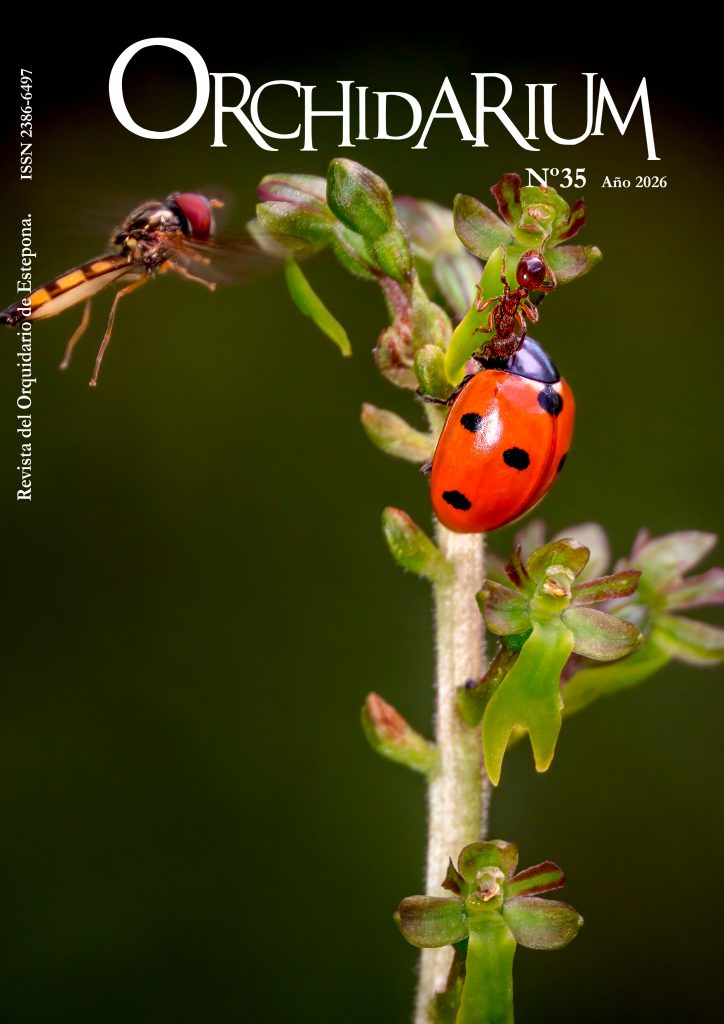
Sinfonía Biótica is featured in issue no. 35 of Orchidarium, the magazine published by the Orquidario de Estepona. The issue already has more than 1,500 downloads. It includes a long article on the permanent interactive installation inaugurated on 24 October 2026, coinciding with the 11th Orchid and Collection Plant Fair. You can download the issue below, or find it on the Orchidarium magazine page. We also wrote about the opening in Listening to the Invisible: When Orchids Played Estepona.
This is the text published in the magazine:
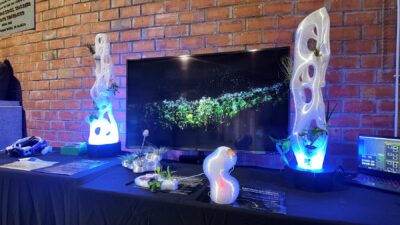
To coincide with the 11th Orchid and Collection Plant Fair, on 24 and 25 October, the Orquidario de Estepona will host a permanent interactive installation in which living orchids generate, in real time, a sonic and visual composition. The piece does not illustrate the garden, nor does it accompany it as a backdrop: it turns the garden into a creative source.
Through the capture of biodata and digital twins of different species, the project proposes a different way of relating to plants: observing them, yes, but also listening to them and interpreting them. The inauguration is scheduled from 24 October 2026. From then on, the public will be able to experience a work that changes at every moment, directed by the vital activity of the specimens connected to the system.
Who made the work: MolinoLab and Fernando Fernández
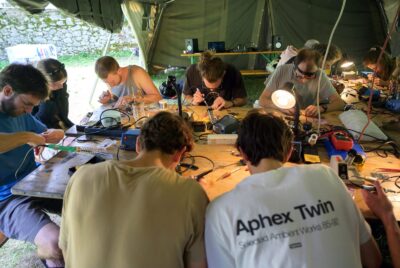
The installation is by Fernando Fernández (@b1tdreamer), an artist and researcher who works at the intersections of art, nature and technology, within the framework of MolinoLab.
MolinoLab is a space for artistic and cultural experimentation in Sancti-Spíritus (Salamanca, Spain). It brings together art, nature and technology through workshops, residencies, gatherings and projects of its own, with a focus on contemporary creation, the self-building of tools, and work in rural contexts. More information at molinolab.org.
One of the projects developed in this context is Sinfonía Biótica, an interspecies creative ecosystem that translates the bioelectrical impulses of living organisms — plants, trees, fungi — into generative, immersive audiovisual experiences. The piece at the Orquidario de Estepona belongs to that line of research and creation: listening to the invisible and turning it into a shared work. The project can be found at sinfoniabiotica.xyz.
A living work at the heart of the orchid house
The proposal articulates two planes that reinforce each other. On the one hand, an immersive experience in the space: generative sound and reactive visuals that respond to the pulse of two orchids. On the other, a digitisation and archival effort that documents flowerings, generates virtual clones, and opens paths for reuse beyond the room.
In the installation, each orchid plays a distinct virtual instrument. Together they form a shared soundtrack for the space, accompanied by an audiovisual composition on a central screen. The result is an adaptive piece: it evolves continuously, without exact repetition, and adjusts to the conditions of the moment.
This is not a poetic metaphor without technical support, but a system designed to translate biological signals into musical and visual parameters with rigour, sensitivity and operational continuity.
What biodata is and how it is captured
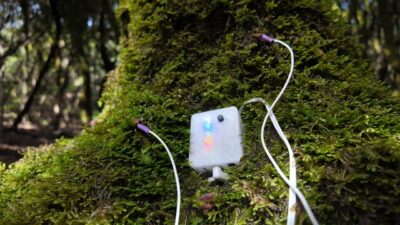
Plants do not “speak” as we do, but they do generate detectable electrical activity. That activity — bioelectrical impulses associated with physiological processes and with the response to their surroundings — can be measured with specific sensors. In this project, those measurements are called biodata.
The system uses biodata units connected to two specimens. The sensors record variations in the plants’ electrical signals and send them to the audiovisual engine. There, those variations are mapped onto creative parameters: in sound, pitch, dynamics, timbre, density, rhythm or effects; in image, movement, density and the behaviour of particles and graphic elements.
It is important to be precise about the scope of this reading. Biodata does not “explain” an orchid’s thinking, nor does it attribute human intentions to the plant. What it makes possible is to render perceptible a normally invisible dimension of its vital activity, and to turn that into artistic material. In that sense, the installation operates as a bridge between biology and aesthetics: it translates the measurable into a shared experience.
The system’s sensitivity requires calibration. Each specimen, each environment and each moment of the day can influence the signal. For that reason, the start-up includes an initial adjustment, response tests and the definition of interpretive ranges, so that the work remains expressive without becoming noisy or illegible.
The sound layer: two instruments, one shared composition
The musical dimension of the installation is conceived as a generative composition. From the real-time capture of biodata from the two orchids, the system builds a sonic texture that changes continuously.
Each plant feeds its own virtual instrument. That differentiation makes it possible to recognise, at least intuitively, several “voices” within the whole: not as literal melodies, but as distinct timbral and dynamic behaviours that converse in the space. The mapping of signals onto musical variables — pitch, dynamics, timbre, density, rhythm, effects — seeks a rich and changing listening experience, able to accompany the visit without imposing itself as background noise or as a closed spectacle.
The spatial mix is designed for the Orquidario: the sound should belong to the place, respect its atmosphere and enrich the experience of those who move among the plants. The work is not presented as a concert with a fixed beginning and end, but as a living sonic state of the space.
The visual layer: morphology, particles and real-time response
The visual dimension unfolds on a central vertical-format screen, chosen to favour the morphological language of the orchids. On it come together animated sequences of previously digitised species, point clouds and reactive graphic elements.
The plants’ electrical impulses alter the movement, density and visual behaviour of the particles. Thus the image does not literally illustrate what is happening at the sensor: it interprets it. The digital twins of different kinds of orchids bring presence, identity and formal variety; the biodata brings variation, breath and contingency.
The result is an interactive composition in the most precise sense of the term: not because the visitor presses buttons, but because the work responds to living organisms present in the same space. The public witnesses a continuous interpretation of what the plants are doing — and ceasing to do — at that instant.
Digitisation, digital twins and archive
In addition to the live experience, the project includes the 3D digitisation of six specimens identified as especially relevant. The process includes scanning, mesh cleaning, optimisation, texturing and final processing, until virtual clones of each specimen are obtained in a particular state of flowering.
These models serve several functions. In the installation, they feed the visual universe and allow the species to be present not only as a motif, but as worked formal material. Outside it, they constitute a visual inventory of flowerings and a base of reusable digital assets: web, exhibition supports, educational materials or future pieces.
Digitisation, therefore, is not an ornamental add-on. It is living documentation of the Orquidario’s botanical heritage and a tool of creative continuity. Preserving a flowering in the form of a digital twin makes it possible to return to it when the plant has already changed, and to open new readings without replacing the experience of the real specimen.
Scope of the project and deliverables
The proposal includes the complete development of the generative sound composition as well as the real-time interactive visual composition; the rental of two biodata units; the digitisation of six specimens and the generation of their virtual clones; transport; and the initial start-up with calibration.
The contemplated deliverables are: an operational interactive audiovisual system in the space; a configured sonification and generative composition engine; a reactive visual system connected to biodata; six processed 3D models, ready for archive and reuse; and basic documentation of use, powering on and off, and an incident protocol.
That documentation is an essential part of the project. A permanent installation is not exhausted on the day of the inauguration: it needs clear criteria for everyday operation, simple maintenance and a response to incidents. The aim is that the Orquidario can sustain the piece with reasonable autonomy, preserving the quality of the experience over time.
Documentation as care for the work
To document, in this context, means several things at once. It means leaving a record of how the system is switched on and off; how one verifies that the sensors are responding; what to do if a signal becomes unstable; how the connected orchids relate to the composition; and how the digital assets generated are organised.
It also means recording the creative and technical process: decisions of sound and visual mapping, criteria for the selection of specimens, flowering states captured in the clones, and calibration conditions. That memory makes it possible to maintain the coherence of the work, facilitate future interventions, and turn the installation into an accumulative project, not an opaque device.
In a centre such as the Orquidario, where science, public outreach and aesthetic experience coexist, that documentary layer reinforces the institutional value of the piece: it is not only an attraction that is being inaugurated; a mediation tool and a living archive are being incorporated.
Future possibilities
Once operational, the installation can grow in several directions without losing its core. On the exhibition side, the digital clones can feed new pieces, online itineraries, educational materials or temporary exhibitions that enter into dialogue with particular flowerings. On the artistic side, more specimens, new virtual instruments or seasonal variations of the composition could be incorporated.
On the scientific and educational side, the biodata — read with caution — can serve to raise awareness of plants’ sensitivity to their environment, and of the complexity of the living beyond what the eye perceives at first glance.
There is also the possibility of setting up residencies, educational collaborations or expansions of the 3D inventory, consolidating a digital archive of the orchid house as a permanent resource. The installation, in that sense, does not close a process: it opens a working framework between biology, technology and contemporary creation.
A new way of being among the orchids
What this project offers the visitor is simple to experience and rich to interpret. To enter the Orquidario and discover that the space sounds and transforms with the plants. To understand, even if only intuitively, that a vital activity is under way. To accept that the beauty of orchids is not exhausted in their visible form: it can also be listened to, mapped, interpreted and documented.
From 24 October 2026, that shared listening will form part of the everyday life of the Orquidario de Estepona. A permanent, generative and interactive installation, in which two orchids take the baton — and the rest of the garden, for a moment, becomes the stage for a work that only they could conduct.
For more information: sinfoniabiotica.xyz · molinolab.org
The full issue can be downloaded from the button below, or from the Orchidarium magazine page.